
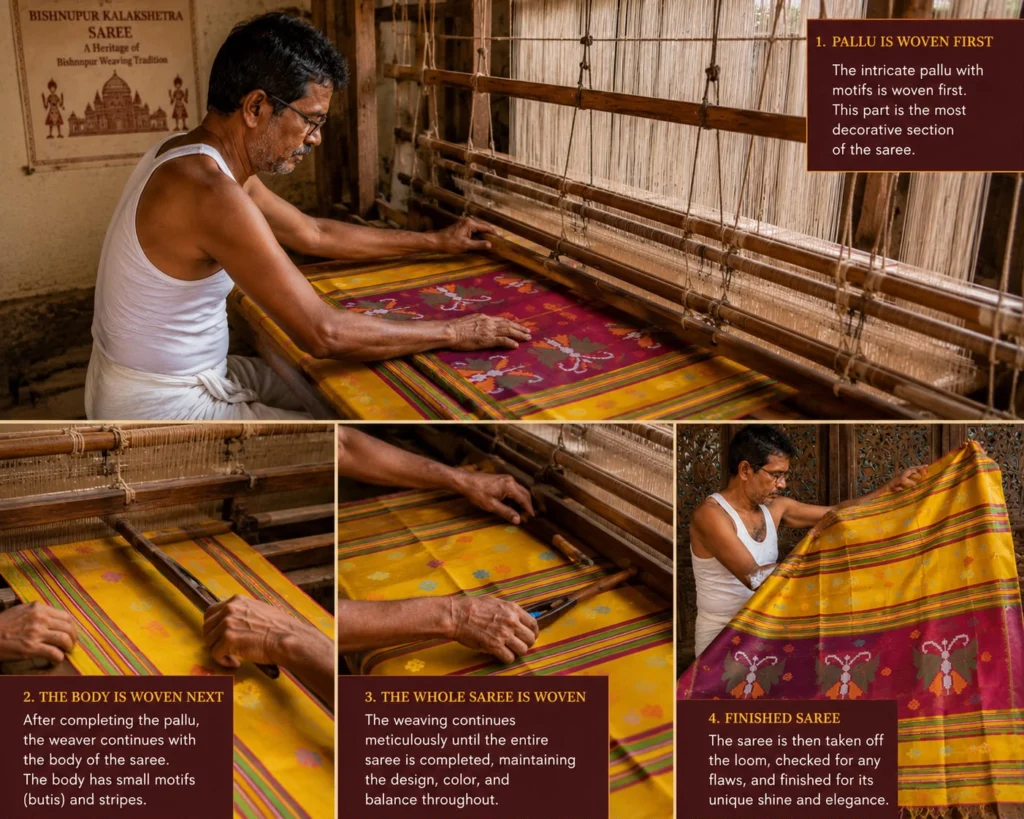
The Bishnupur Kalakshetra Sari, also known as the Biswa Bangla Sari, is a relatively recent addition to Bengal’s rich textile heritage. Emerging only within the last few years, it has quickly gained recognition for its vibrant colours, distinctive patterns, and elegant craftsmanship. While its name may evoke comparisons with the celebrated Kalakshetra sari tradition of South India, the connection remains uncertain. Beyond a shared appreciation for bold colour palettes, contrasting pallus, and occasional bird or animal motifs, the two weaving traditions are fundamentally different.
The story of the original Kalakshetra sari begins nearly eight decades ago with the visionary Bharatanatyam exponent Rukmini Devi Arundale. After establishing the renowned Kalakshetra institution in Chennai in 1936, she founded a weaving section as part of her mission to revive and preserve India’s traditional arts and crafts.
Initially, the weaving initiative focused on creating handwoven sarees for Bharatanatyam dancers. However, it soon evolved into a distinctive design movement of its own. Rukmini Devi collaborated closely with master weavers, reviving forgotten techniques and developing an aesthetic language that combined simplicity, elegance, and timeless appeal.
One of the defining characteristics of the South Indian Kalakshetra sari is the Korvai technique. In this highly skilled process, the sari body and border are woven separately and then joined through an intricate interlocking method. The result is a striking contrast between the body and border while maintaining exceptional structural integrity—an enduring testament to the artistry of traditional South Indian weaving.
The Bishnupur Kalakshetra sari, despite its name, does not employ the Korvai weaving technique. Whether inspired by the visual appeal of its southern counterpart or simply sharing a coincidental name, Bengal’s weavers have adapted the concept through their own creative lens.
True to Bishnupur’s longstanding tradition of innovation and artistic excellence, local artisans have incorporated distinctly Bengali design elements into these sarees. Features such as Jamdani-inspired motifs, intricate geometric patterns, and the characteristic Chatay borders lend the sari a unique regional identity.
Rather than replicating the South Indian tradition, the Bishnupur Kalakshetra sari represents a reinterpretation—one that honours Bengal’s weaving heritage while embracing contemporary design influences. The result is a textile that feels both modern and rooted in tradition, reflecting the evolving nature of Indian handloom craftsmanship.
The emergence of the Bishnupur Kalakshetra sari highlights the dynamic spirit of Bengal’s weaving communities. It demonstrates how traditional artisans continue to innovate while remaining connected to their cultural roots.
Today, these sarees stand as symbols of creative adaptation—where inspiration, craftsmanship, and regional identity come together to create something uniquely Bengali. As they continue to gain popularity, the Bishnupur Kalakshetra sari serves as a reminder that India’s textile traditions are not static relics of the past but living art forms that evolve with each generation.