Tamil Nadu’s handloom heritage is a living tapestry of elegance, resilience, and cultural depth—where every weave reflects centuries of devotion to craft. Renowned for its mastery over luxurious silks and enduring cottons, the state remains a proud custodian of some of India’s most iconic textiles.
At the heart of this enduring legacy lies the Kanchipuram silk saree—an exquisite weave crafted from pure mulberry silk and enriched with intricate zari work inspired by temple architecture, sacred motifs, and the grandeur of Tamil culture. Alongside it flourish the vibrant Chettinad cottons, celebrated for their striking colours, bold patterns, and timeless comfort.
Across weaving clusters such as Kanchipuram, Salem, Madurai, and Arani, generations of artisans continue to preserve techniques that have been passed down through centuries. Each region contributes its own distinct identity through motifs, textures, and weaving traditions, creating textiles that are far more than garments—they are expressions of heritage, memory, and artistry.
The Kanchipuram silk saree, born in the sacred temple town of Kanchipuram, is not merely a garment—it is a symbol of tradition, devotion, and timeless grace. Across South India, particularly in Tamil Nadu, Kerala, Karnataka, and Andhra Pradesh, it holds a cherished place in weddings, festivals, and family celebrations. Passed lovingly from one generation to the next, it becomes not just attire, but an heirloom woven with emotion and memory.
Recognised with the Geographical Indication (GI) tag in 2005–2006, the Kanchipuram saree stands as a protected cultural treasure. Behind every weave are thousands of artisan families whose lives are deeply connected to the loom, preserving an art form that continues to define Tamil Nadu’s textile heritage.
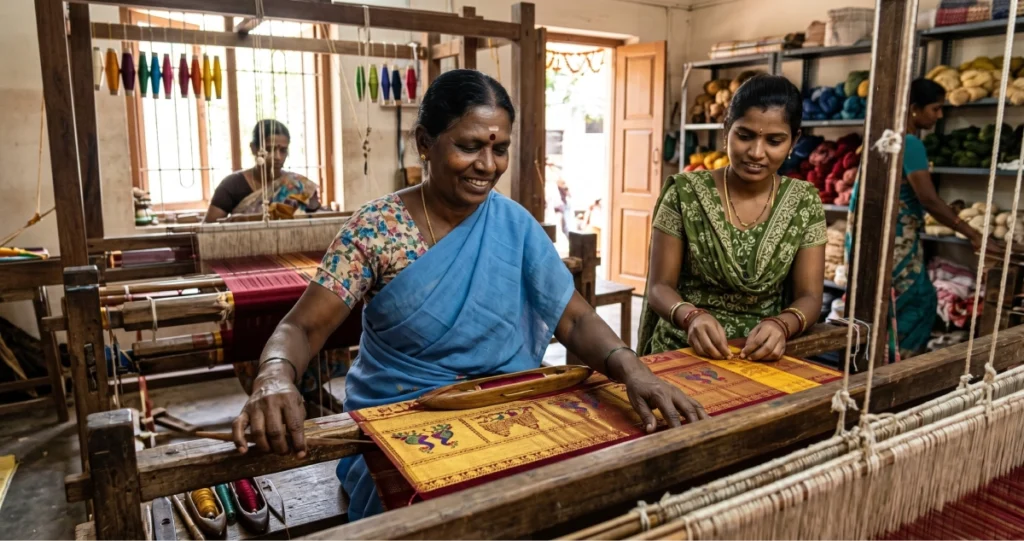
Crafted using the finest mulberry silk and luminous zari, the making of a Kanchipuram saree is a meticulous and highly skilled process. Traditional weaving involves the coordinated movement of three shuttles operated by the weaver and an aide, carefully bringing together the body, border, and pallu—often woven separately before being seamlessly interlocked.
One of the defining features of the saree is its legendary korvai technique, where contrasting borders are joined to the body with extraordinary precision. The subtle zigzag interlocking line is more than a visual signature—it reflects durability, craftsmanship, and the strength of tradition itself. Even with the passage of time, the borders often remain intact, preserving the saree’s beauty for generations.
The motifs woven into every Kanchipuram saree draw inspiration from temple gopurams, mythical symbols, floral patterns, and the richness of nature. Its vibrant hues represent celebration, auspiciousness, and cultural identity, making every saree a masterpiece of storytelling through silk.
To wear a Kanchipuram saree is to embrace a living heritage—one that carries the artistry of skilled hands, the spirit of Tamil culture, and the timeless beauty of India’s handloom traditions.