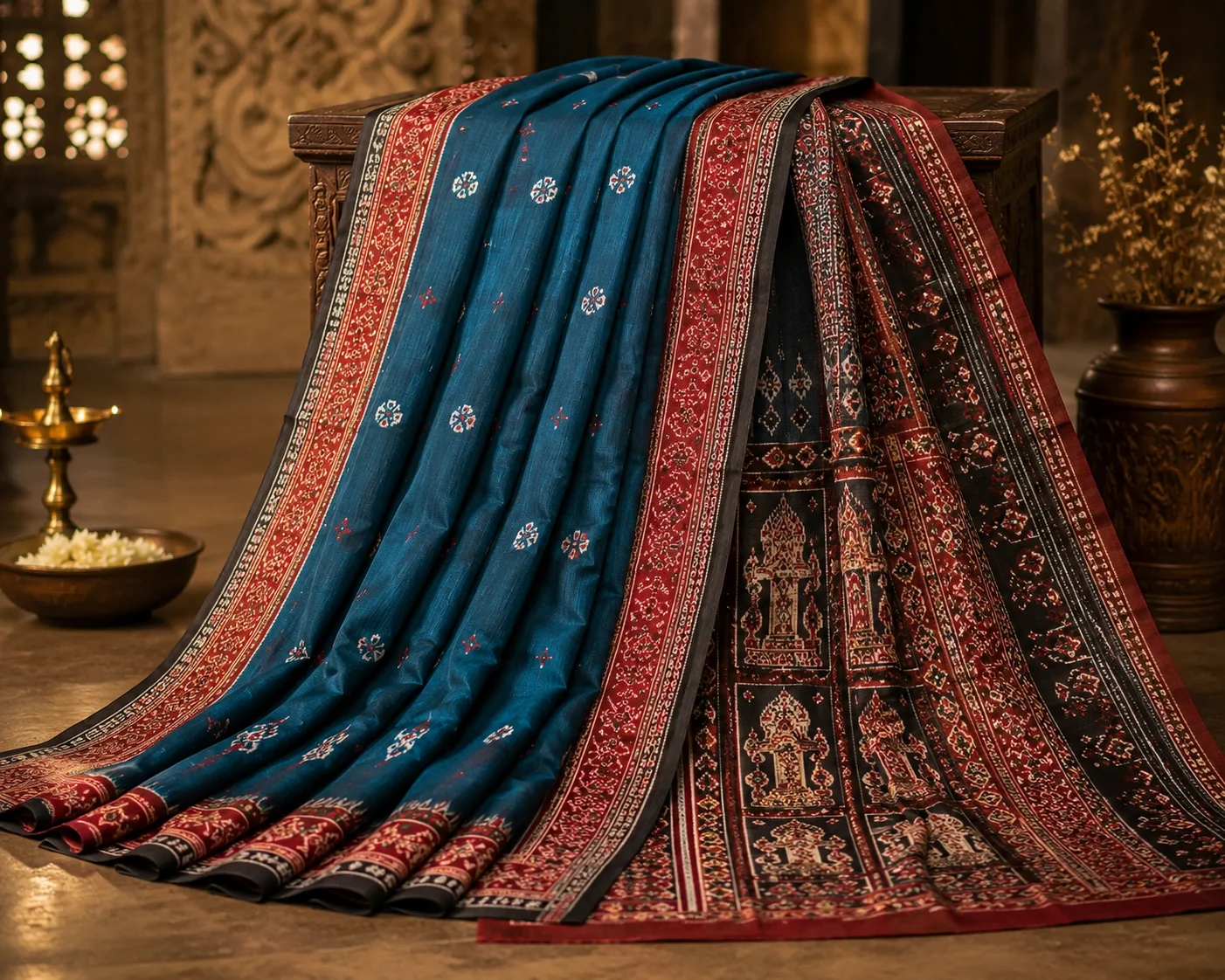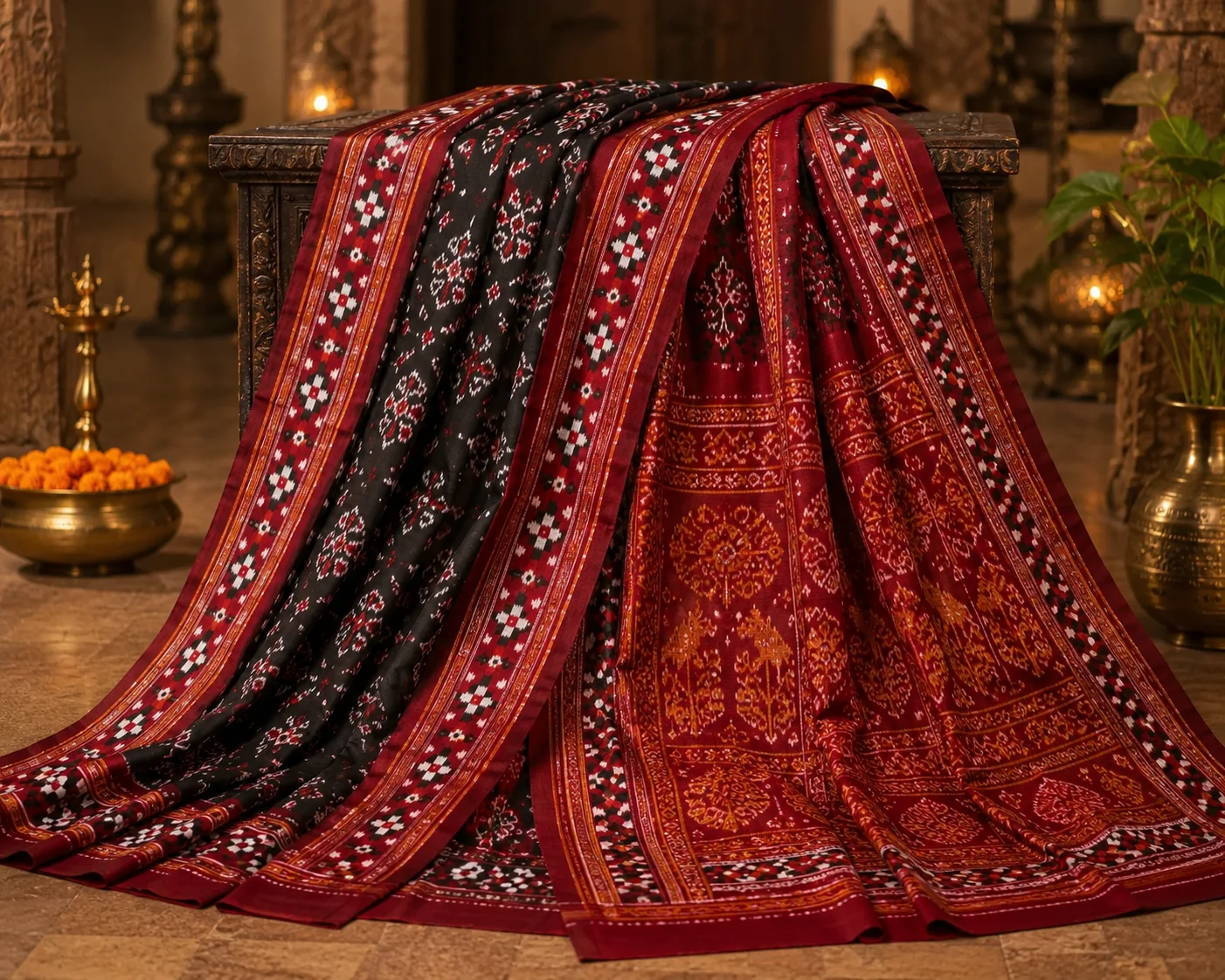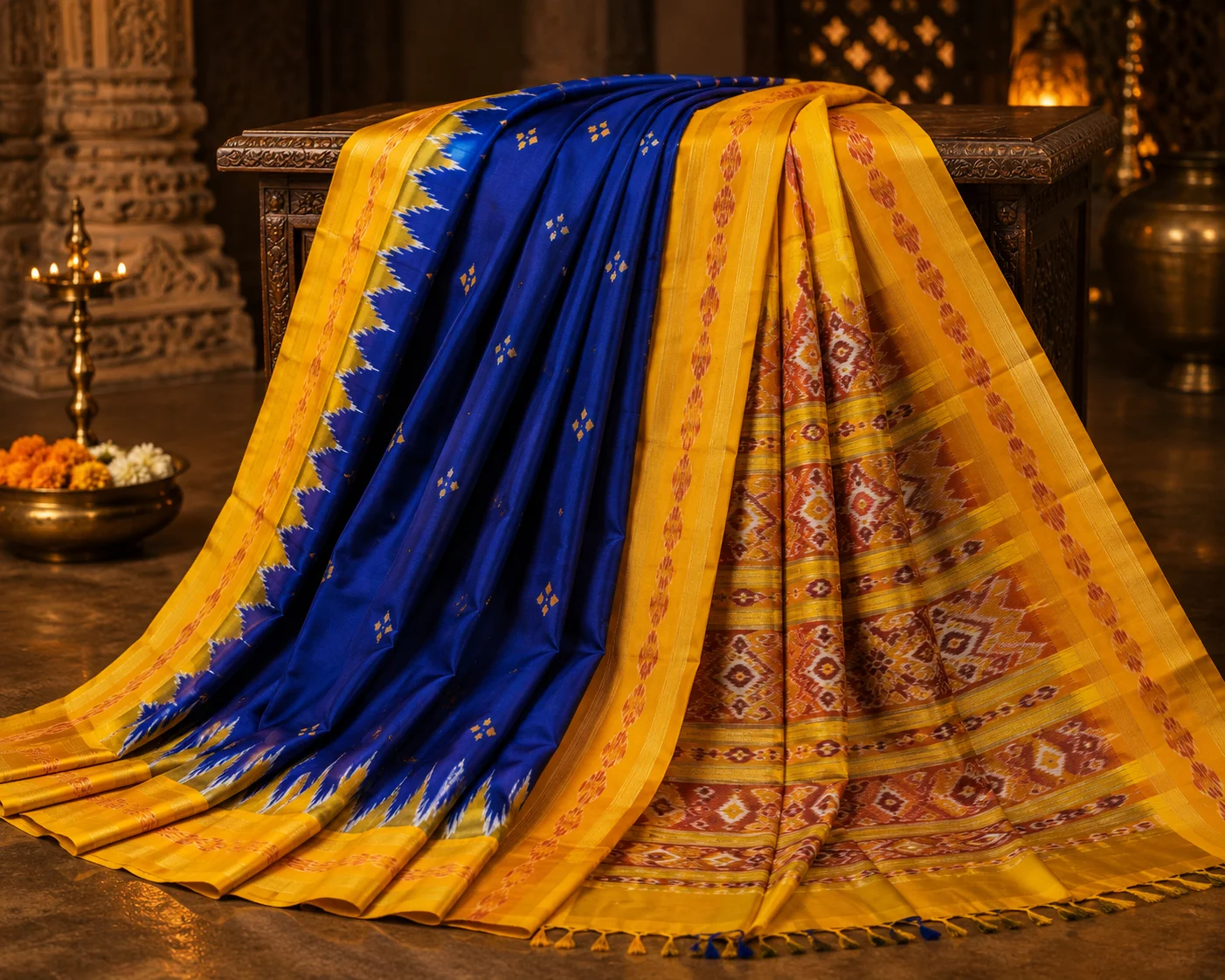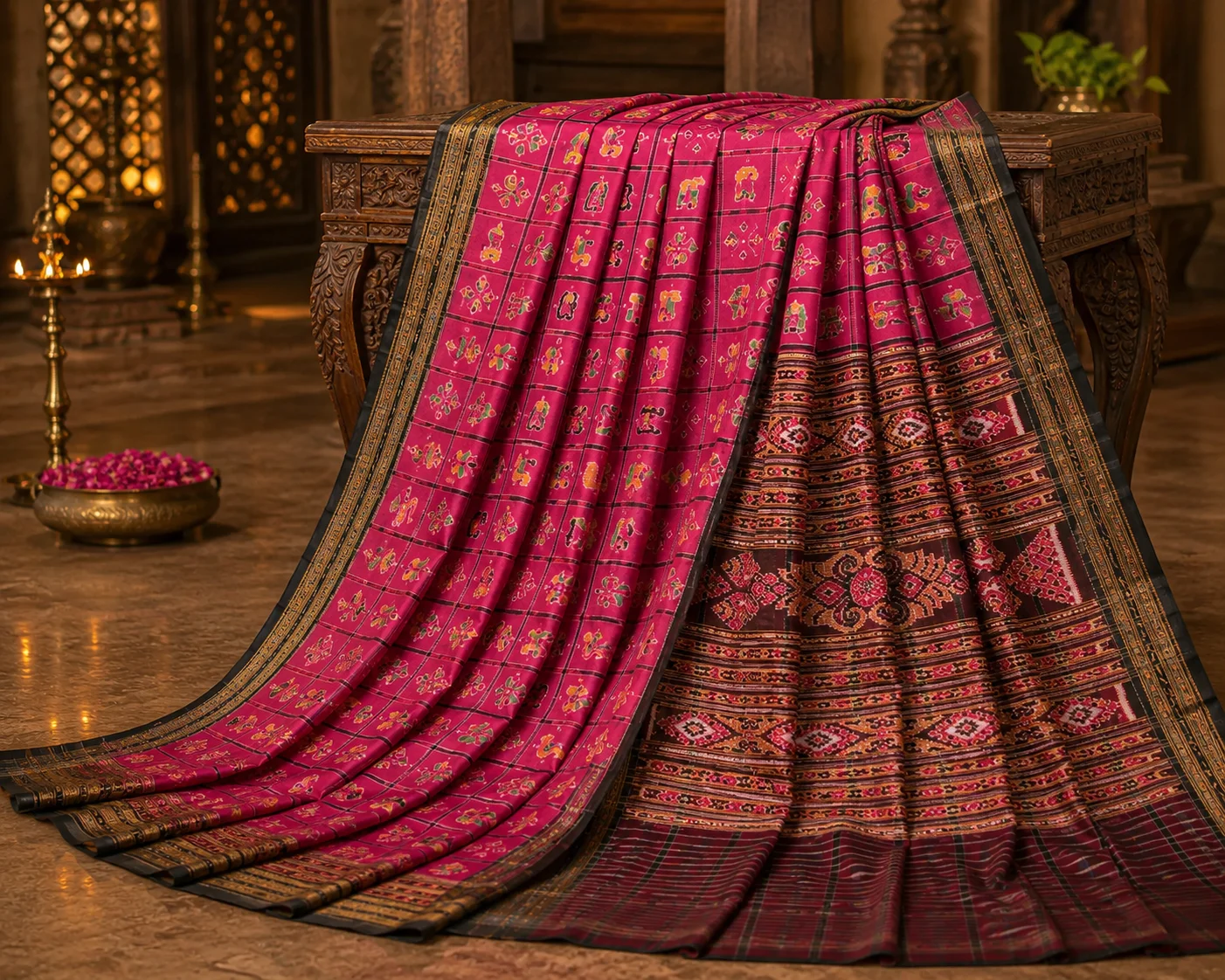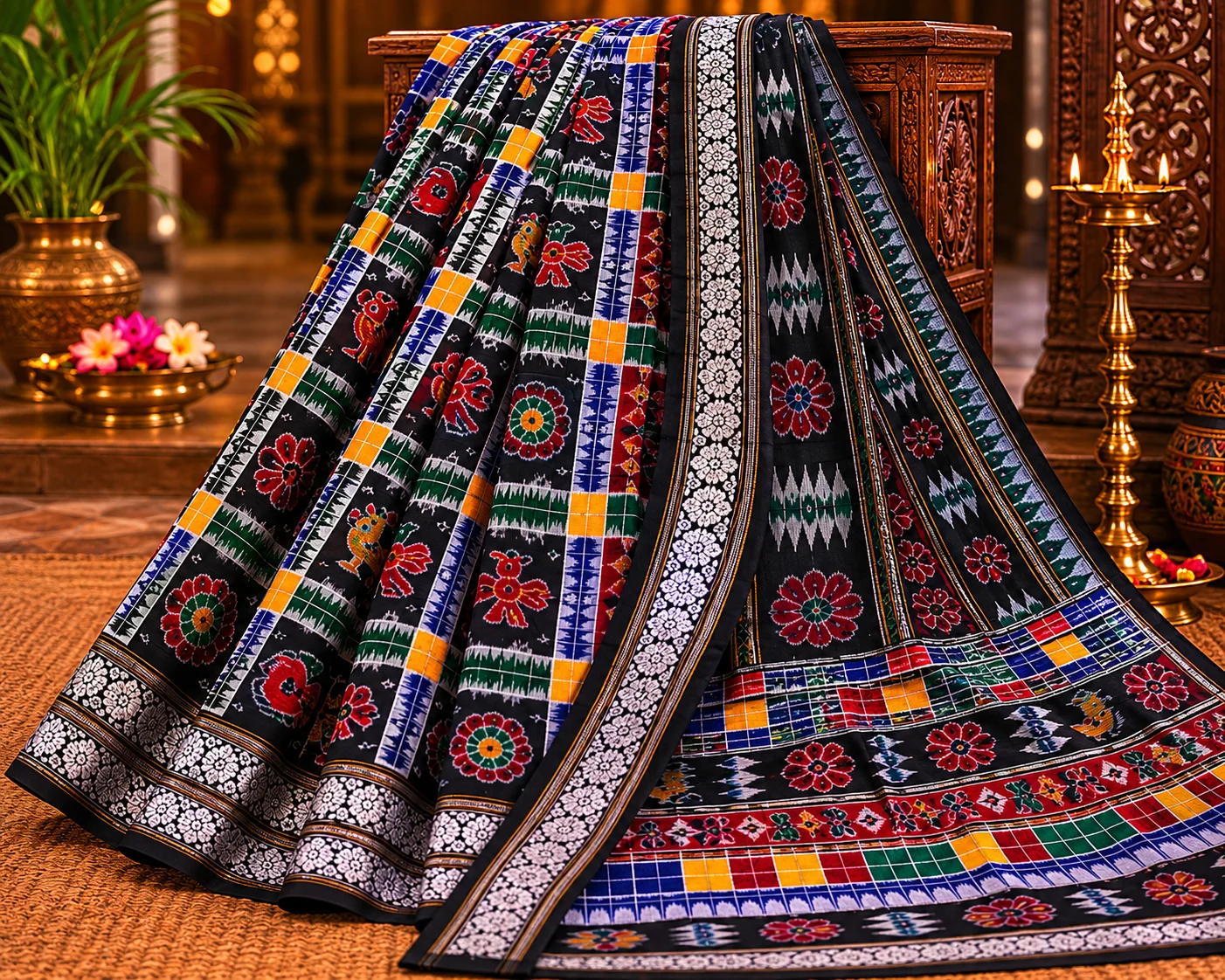
The Sambalpuri saree—reverently known as the Bandha saree—is not merely a textile, but a lyrical expression of Odisha’s soul. Though named after Sambalpur, its legacy flows across the weaving heartlands of Bargarh, Sonepur, and Barpali—regions once part of the undivided Sambalpur, united by a shared language of loom and tradition.
At the heart of this craft lies the intricate Bandhakala (Ikat) technique—one of the most revered weaving styles in India. In this process, threads are tie-dyed before they are woven, requiring extraordinary foresight and precision. In single Ikat, either the warp or weft is dyed; in double Ikat, both are meticulously prepared. The result is nothing short of magical—patterns that emerge with a soft, almost fluid clarity, mirrored nearly identically on both sides of the fabric. It is said that this technique shares an ancient connection with Indonesian textile traditions, hinting at a cultural dialogue that transcends borders and time.
Each Sambalpuri saree is a canvas of meaning. Motifs like the shankha (conch), chakra (wheel), and phula (flower) are not mere decorations—they are symbols of spirituality, identity, and the rhythm of life deeply rooted in Odia culture. These sarees do not just adorn; they narrate.
Over time, Sambalpuri sarees have evolved into a diverse family of weaves—each with its own character and charm. From the elegance of silk to the breathable grace of cotton, they are available in forms such as Sambalpuri Ikat, Pasapalli, Bomkai, Pata, and the vibrant Bichitrapuri.
The Bichitrapuri saree, innovated by Krutartha Acharya, is a striking variation known for its checkerboard body and symbolic motifs inspired by Lord Jagannath. It beautifully blends tradition with creative evolution, keeping the craft alive yet ever-changing.
Equally iconic is the Pasapalli saree, recognized by its bold chessboard-like checks—sometimes delicate, sometimes dramatic—woven in contrasting colours. While it shares the Ikat technique with Sambalpuri weaves, its visual language is uniquely its own, especially in the pallu and layout.
What elevates the Sambalpuri saree to an elite space in Indian handloom is not just its technique, but its spirit. It is handwoven creativity at its finest—a reflection of Odisha’s heritage, its stories, and its enduring artistic discipline. Each saree carries the imprint of the artisan’s hands, shaped by patience, experience, and generations of inherited knowledge.
Its journey from regional craft to national icon was further illuminated when Indira Gandhi chose to wear it—bringing the elegance of Sambalpuri weaves into the national spotlight.
And yet, beyond recognition and acclaim, the Sambalpuri saree remains deeply personal. It is a piece that often finds its way into every saree lover’s wardrobe—sometimes bought, often inherited, always cherished.
To wear a Sambalpuri saree is to drape oneself in a living tradition—where every thread holds a story, every motif carries meaning, and every weave becomes a timeless expression of culture, identity, and quiet artistry.
The Khandua silk saree is not just a textile of Odisha—it is devotion made visible, a sacred weave where poetry, faith, and craftsmanship come together in perfect harmony. Its origins are deeply intertwined with the spiritual traditions of Puri and the divine presence of Lord Jagannath.
Legend and history beautifully converge in the 12th century, when the poet Jayadeva offered his immortal composition, the Gita Govinda, not merely as words—but as woven devotion. In his birthplace of Kenduli, these lyrical verses were intricately rendered onto fabric using the tie-and-dye (Bandha) technique, transforming cloth into a sacred offering.
So profound was this act that the King of Puri commanded the skilled weavers of Nuapatna (Tigiria) to continue this tradition—ensuring that the deity would be adorned in textiles that carried poetry within their threads. To this day, Khandua fabric forms the Angavastra of Lord Jagannath, making it not just attire, but an integral part of ritual and reverence.
Primarily woven in Nuapatna and Maniabandha, Khandua sarees—also known as Kataki or Maniabandhi—are crafted from fine mulberry silk, though cotton variants also exist for ritual use. Light in weight yet rich in meaning, these sarees are often created in auspicious hues of red, orange, maroon, and cream—colours that signify purity, energy, and sacredness.
The artistry lies in its single Ikat (Bandha) technique, where either the warp or weft threads are tie-dyed before weaving, demanding immense precision and foresight. The famed temple borders (Kumbha) are often achieved using the Phoda technique, adding structure and symbolism to the weave.
Motifs on a Khandua saree are deeply narrative—drawn from mythology, nature, and temple art. One finds the shankha (conch), chakra (wheel), lotus, fish, elephants, peacocks, and even the mystical Nabagunjara—each symbol carrying spiritual resonance. The pallu, often arranged in horizontal panels, may depict stories, devotional imagery, or even the verses of the Gita Govinda, turning the saree into a sacred manuscript.
Unlike other Ikat traditions, Khandua sarees often feature a relatively simple or plain border, allowing the body and pallu motifs to take center stage. The weaving process itself is intricate and time-intensive—beginning with winding and warping, followed by careful design setting, drafting, and weaving—much of it still done using traditional tools like the charkha, often by women artisans.
Despite its deep-rooted tradition, Khandua has gracefully evolved. Contemporary weavers experiment with clearer motifs and varied dyeing techniques, making the saree more versatile while preserving its soul. Remarkably lightweight—often around 300 grams—it offers both elegance and comfort, making it timeless across generations.
From temple rituals to Odissi dance performances, from weddings to sacred ceremonies, the Khandua saree continues to hold a place of reverence. To wear it is not merely to adorn oneself, but to carry a living tradition—where every thread is a prayer, every motif a story, and every weave an offering to the divine.
The Nabakothi saree is a quiet marvel within Odisha’s rich handloom tradition—an intricate tapestry of symbolism, precision, and cultural memory. Woven in the weaving clusters of Sambalpur and surrounding regions, it is available in both silk and cotton—each carrying its own distinct experience, yet bound by the same artistic soul.
The Nabakothi silk saree, crafted from fine silk yarn, exudes a rich, luminous texture—graceful, ceremonial, and deeply rooted in tradition. In contrast, the Nabakothi cotton saree offers a softer, lighter embrace—breathable and effortless, perfectly suited to the warmth and rhythm of everyday life in Odisha. Together, they reflect a beautiful balance of grandeur and comfort.
At the heart of this weave lies its name—Nabakothi, meaning “nine grids” in the Odia language. These nine carefully structured boxes form the canvas of the saree, each filled with a distinct motif, each motif carrying a story. It is not just design—it is a language of symbols, passed down through generations of skilled hands and patient hearts.
The weaving process itself is an act of devotion. Using traditional Ikat techniques, the threads are dyed with foresight and woven with remarkable precision, ensuring that each motif aligns perfectly within its grid—an orchestration of discipline and artistry.
Within these nine spaces, life unfolds:
Each saree becomes more than an adornment—it becomes a story told in fragments, a collection of beliefs, hopes, and cultural echoes brought together in harmony.
To wear a Nabakothi saree is to carry nine worlds within one drape—each grid a window into tradition, each motif a whisper of meaning, and each thread a testament to Odisha’s timeless artistry.
Introducing the Utkala Lakshmi Sambalpuri cotton saree—a true masterpiece of Odisha’s handloom legacy, where devotion, precision, and artistry come together in perfect harmony. Rooted in the weaving traditions of Sambalpur, this saree is not merely worn—it is experienced.
Crafted using the intricate double Ikat technique, where both warp and weft threads are dyed before weaving, the Utkala Lakshmi saree reflects an extraordinary level of skill and foresight. Every motif must be imagined in advance, aligned with mathematical precision, and brought to life through patient craftsmanship—resulting in patterns that appear almost seamless, identical on both sides, like a quiet miracle in thread.
Woven primarily in fine, high-count cotton, the saree is light, breathable, and beautifully suited for warm climates. Yet within this softness lies remarkable strength—Sambalpuri cotton is known for its durability, retaining its vibrancy and character even after years of wear.
Its colours—rich reds, fresh greens, and luminous yellows—come together in a vibrant harmony, celebrating life, festivity, and tradition. The borders are adorned with intricate geometric or temple-inspired patterns, while the pallu unfolds like a story—often featuring Jhoti-Chita inspired designs and symbolic motifs that reflect Odisha’s cultural essence.
At the heart of the Utkala Lakshmi saree lies its deepest meaning. The recurring Padma (lotus) motif represents Lakshmi—the goddess of wealth, grace, and auspicious beginnings. Traditionally, these sarees were gifted to brides, as a new bride is seen as the embodiment of Lakshmi herself—bringing prosperity, beauty, and harmony into a new home.
The saree often features Pasapalli (chessboard) patterns, with each square holding intricate motifs—lions, elephants, deer—symbols of strength, wisdom, and abundance. Borders may carry Rudraksha or Kumbha (temple) designs, grounding the saree in spiritual symbolism.
Measuring approximately 6.3 meters with a blouse piece, and often recommended for gentle care or dry cleaning, this saree is as enduring as it is elegant. It represents not just sustainable craftsmanship, but a deeply authentic tradition—where every thread is handwoven, every motif intentional, and every saree unique.
The Utkala Lakshmi saree does not demand embellishment. Worn with minimal jewellery, it allows its intricate artistry to speak—softly yet powerfully. It is charming, alluring, and timeless.
To drape it is to carry a blessing—of heritage, of prosperity, and of a craft that continues to thrive through the hands and hearts of Odisha’s weavers.
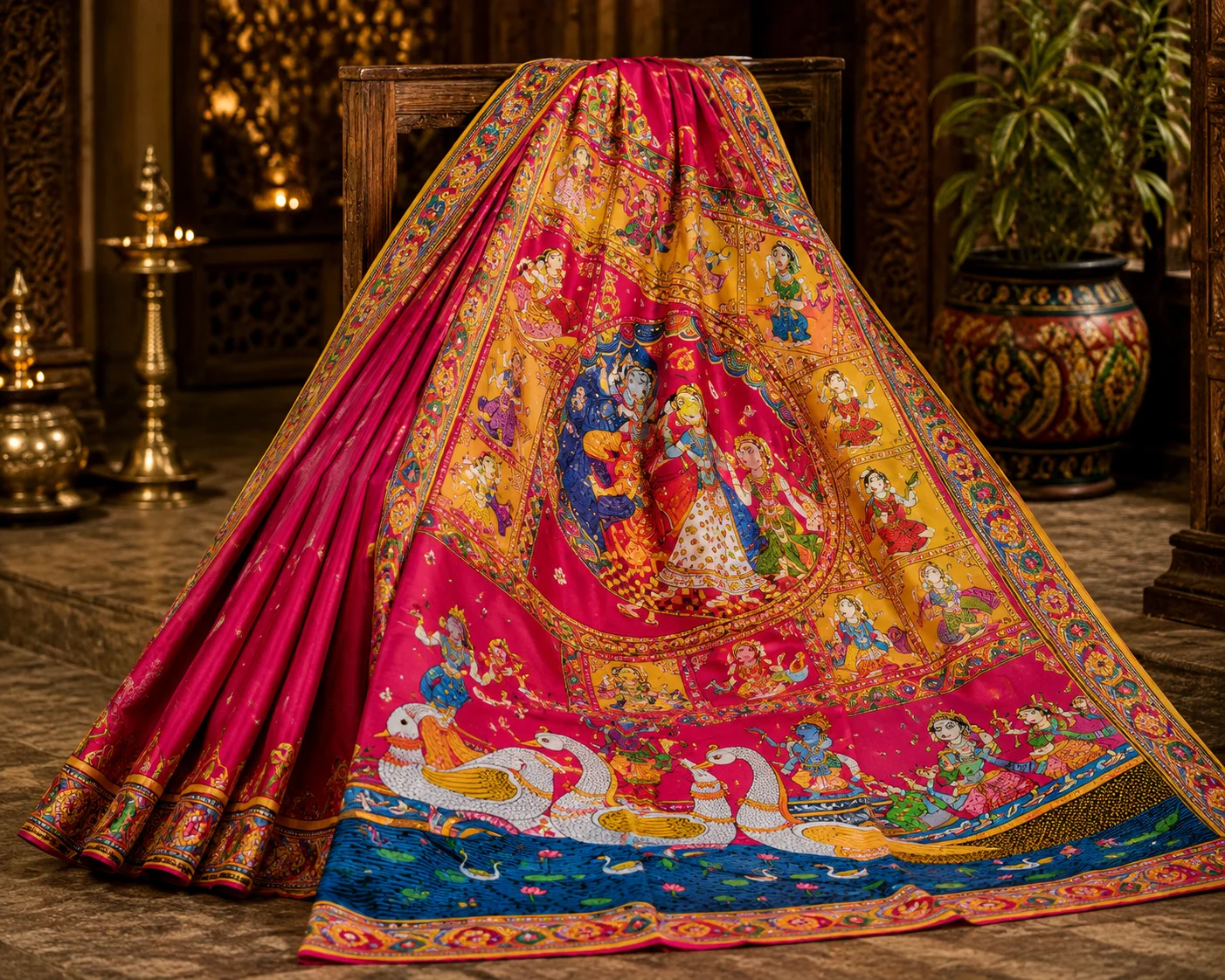
The Pattachitra saree is not just a garment—it is a canvas of devotion, a story painted in colour, and a timeless expression of Odisha’s artistic soul. Rooted in an ancient tradition that flourished centuries ago, this art form transforms fabric into narrative, where every brushstroke carries myth, memory, and meaning.
The word Pattachitra itself comes from Sanskrit—patta meaning cloth or canvas, and chitra meaning painting. True to its name, these sarees are adorned with intricate hand-painted designs, often created on fine silk such as Tussar, where the pallu and body become a living tapestry of stories. Closely associated with the sacred traditions of Puri and the worship of Lord Jagannath, Pattachitra art has long been a medium of devotion—where painting itself becomes an offering.
What makes these sarees extraordinary is the painstaking craftsmanship behind them. Each motif is painted by hand using natural, earth-derived colours—vermilion red from hingula (cinnabar), yellow from haritala (orpiment), white from powdered conch shells, and deep black from lamp soot. These pigments, bound with natural resins, give the artwork a depth and longevity that feels almost eternal.
The themes are deeply narrative and spiritual. Scenes from the life of Lord Krishna, depictions of temple rituals, graceful dancers (nartaki), and intricate representations of flora, fauna, and tribal life unfold across the fabric. Every saree tells a story—sometimes mythological, sometimes cultural, always deeply rooted in tradition.
Worn during festivals, weddings, and cultural celebrations, the Pattachitra saree carries a quiet grandeur. Whether inspired by the vibrancy of Krishna Janmashtami or the elegance of traditional rituals, it stands apart—not for opulence alone, but for its artistry. It is, in the truest sense, wearable art.
Often paired with handwoven silks or combined with other traditional techniques, these sarees bridge painting and weaving, bringing together two art forms in seamless harmony. No two pieces are ever identical—each one is a singular expression of the artist’s hand and vision.
To wear a Pattachitra saree is to drape a story—one that has travelled through centuries, carried by artisans who paint not just with colour, but with devotion. It is where cloth becomes canvas, and tradition becomes timeless.
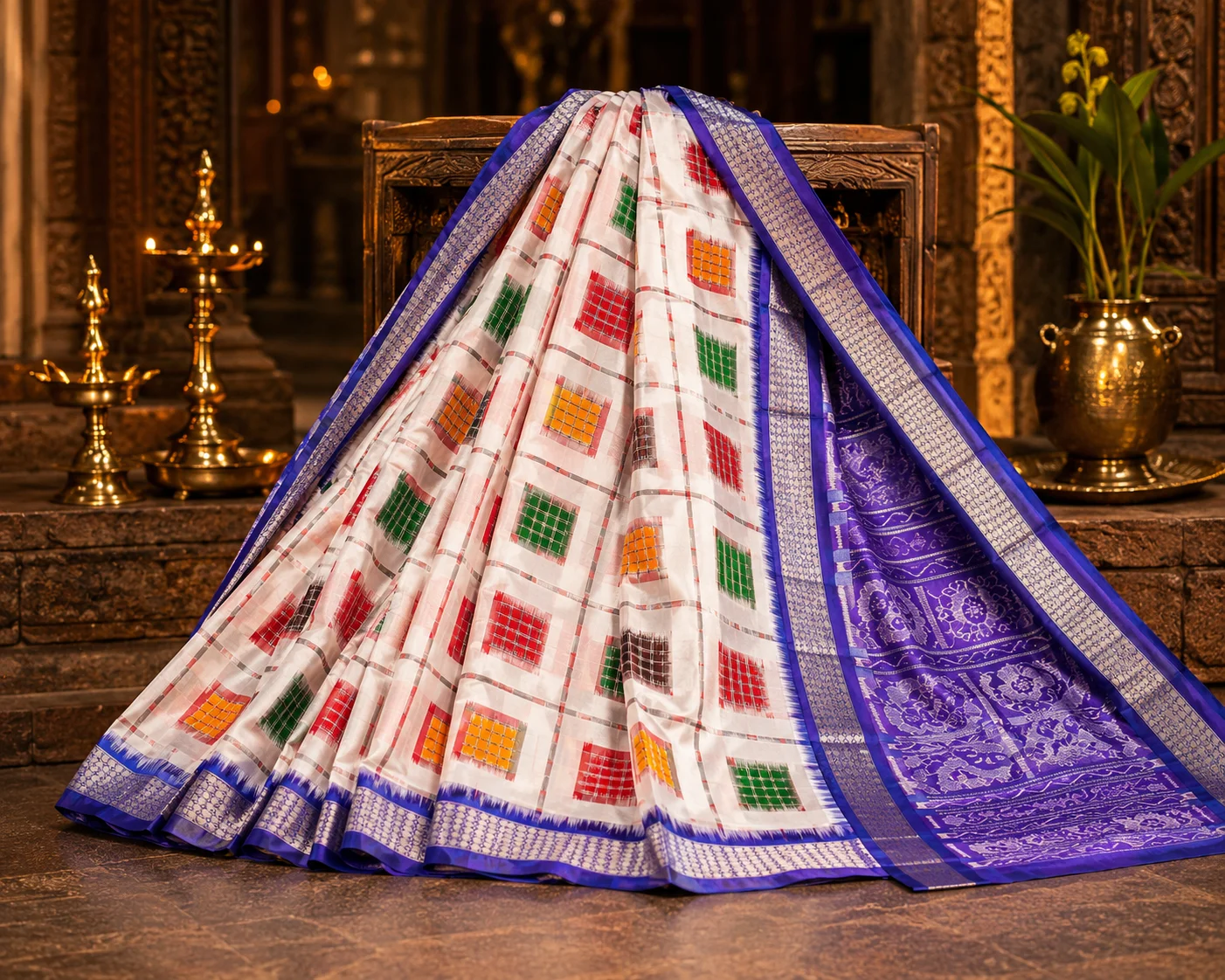
The Ashwini saree—often known as Ashwini Patta—is one of Odisha’s most refined handloom expressions, where precision meets poetry in thread. Emerging from the celebrated weaving traditions of Sambalpur, it belongs to the illustrious Sambalpuri Ikat lineage, yet stands apart for its quiet complexity and distinctive visual rhythm.
At the heart of the Ashwini saree lies the demanding double Ikat (Bandhakala) technique—an art form where both warp and weft threads are painstakingly tie-dyed before weaving begins. This requires not only technical mastery, but an almost intuitive foresight, as every motif must align perfectly when the threads finally meet on the loom. The result is a fabric where patterns appear with a soft, blurred beauty—identical on both sides, like a mirror of craftsmanship.
What defines the Ashwini saree is its signature arrangement of small, spaced-out squares—delicate checks that create a sense of rhythm and balance across the body. Often set against a serene white or light-toned base, these multicoloured motifs come alive with quiet vibrancy, framed by contrasting borders—frequently in deep maroon or traditional hues, sometimes adorned with Rudraksha or temple-inspired elements.
Within these geometric grids, tradition finds expression through timeless symbols—shankha (conch), chakra (wheel), and phula (flower)—motifs that echo spirituality, continuity, and the beauty of everyday life in Odisha. The pallu, or anchal, often unfolds with greater intricacy, featuring floral compositions and detailed patterns that complete the narrative of the saree.
Woven in both fine cotton and luxurious silk, the Ashwini saree offers a rare balance of comfort and grandeur. The cotton variants are light, breathable, and ideal for everyday elegance or formal wear, while the silk versions bring a richer, more ceremonial presence—perfect for weddings, festivals, and special occasions.
Recognized under the Geographical Indication (GI) tag of Sambalpuri textiles, the Ashwini saree is more than a product—it is a protected heritage, representing a high level of craftsmanship passed down through generations.
To wear an Ashwini saree is to embrace a masterpiece of discipline and artistry—where every square holds intention, every motif carries meaning, and every thread reflects the enduring brilliance of Odisha’s handloom tradition.